By Dorsey Griffith
Contributing Writer
As the saying goes, necessity is the mother of invention, and amid the COVID pandemic nurse educators found innovative ways to keep both faculty and students in the game. What they didn’t anticipate was that many of their crisis-driven efforts would be good enough to keep for the foreseeable future.
From virtual orientation programs to community-based preceptorships and interactive online clinical training, educators opened doors to more flexible, efficient, and in many cases, effective approaches to training the next generation of NPs. Here are a few examples from around the state.
Orientation Goes Online at Betty Irene Moore School of Nursing
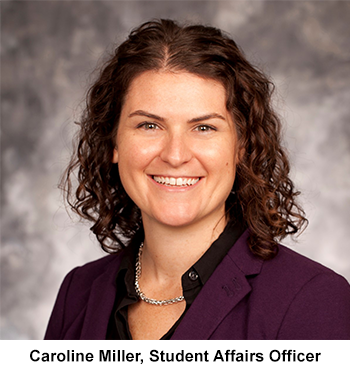
It was a lot to take in. Three long days in a room of 135 people learning everything from how to set up multiple computer applications, apply for financial aid, use the handbook, and network with new peers. The “Leadership Immersion” program was not only logistically challenging for faculty, but exhausting for students, said Student Affairs Officer Caroline Miller.
“It’s very tiring to be in a room that large all day long,” she said. “It drains your energy in a way.”
When in-person orientation was no longer an option, Miller and her team developed a virtual program combining work that could be done independently with live interactive sessions with smaller groups.
“It was a huge task, but I could tell immediately that this was something we would keep doing.”
Miller delivers the information to students incrementally.
“Every week students receive a few new topics of information, like how to set up an email account, library resources, and topics from the handbook,” she said.
She collected presentations and PDFs from various university departments and moved them online so that students could absorb the information on their own time and find the material easily whenever they need it.
“I liked that it broke up everything instead of just throwing it all on us at once,” wrote one student. “It helped decrease a lot of anxiety and stress with taking care of the logistical stuff.”
Miller also sent out a weekly discussion post so students could introduce themselves with personal anecdotes that elicited friendly online discussions and spawn relationships. And she separated the school’s three new cohorts (NPs, PAs and MSN students) and developed individual live events via Zoom, in which students could interact with one another and with faculty as groups or in virtual breakout rooms.
“It was wonderful to finally have some facetime with faculty and my cohort,” one student wrote. “I think the interactions and small breakout rooms really help us all learn how to use interactive technology platforms such as Zoom.”
Miller said her team is still exploring whether to continue the synchronous interactive sessions or go back to in-person events next June, but the materials will stay online.
“We pulled out so much of the content that had been presented in the three-day events so that now when we go back, we can be very intentional, and it will feel more relaxed,” she said.
Virtual Intensives at Samuel Merritt Enhances Telehealth Training
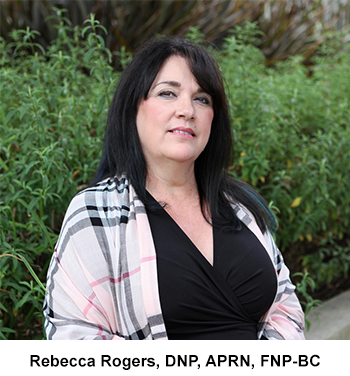
Before the pandemic, nursing school leaders at Samuel Merritt were focused on bringing their FNP-MSN and DNP-FNP students onto campus for weekend-long intensive sessions with faculty to focus on problem-based learning scenarios.
“Then COVID hit like a thunderbolt,” said Rebecca Rogers, DNP, APRN, FNP-BC, who directs the DNP program. “So we quickly moved this type of learning into an online, interactive program.”
She calls the effort an application of the “diffusion of innovation” theory that describes the pattern and speed at which new ideas and technologies spread – a concept widely employed during the pandemic.
“Technology had to take the place of face-to-face interaction and education,” she said. “For our Sacramento FNP campus, we got very innovative and set up virtual exam rooms with standardized patients.”
The intensives were set up just as they would be in person so that students could interact with standardized patients, then go into a breakout room to discuss the case and develop a care plan with a faculty member before going back in with the standardized patient to treat the patient.
Rogers said they used to the technology to get the job done, but also to take training to the next level, which was how to function in a telehealth environment. These are vital skills, she said, especially for NPs who plan to work in rural communities.
“We now are preparing NPs to go out into the workforce with a really strong background in telehealth. I think no matter what, we have proven that telehealth is effective and safe, and we can still provide high-quality care. Now we at the university level are producing students with this extra level of preparedness. COVID has taught us we have to rethink what we do.”
Moving forward, Rogers said, the standardized patient experience will likely be a combination of virtual and in-person experiences for students.
“There is so much benefit to having a multi-focal approach to education and producing these well-rounded grads,” she said.
Thinking Outside the Box (literally) to Provide Preceptorships at Holy Names University
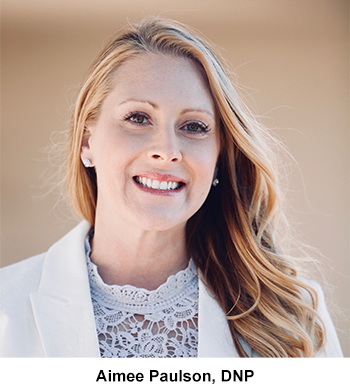
Every nursing program in California struggled this past year to find suitable preceptorship opportunities for students to meet their clinical requirements for graduation. The pandemic shut clinics and tightened hospital rules. Many providers had put safety for themselves and patients ahead of supporting nursing students as preceptors. And students themselves were fearful of contracting the virus before a vaccine was available.
“It delayed program completion for some students because their preceptors’ offices were closed, or facilities were no longer allowing non-essential employees,” said Aimee Paulson, DNP and chair of the Holy Names School of Nursing Graduate Program. “That has been tough. It delays their entry into the workforce at a time when the shortage of primary care providers is growing.”
While the state Board of Registered Nursing allowed a portion of clinical hours above the 500-hour minimum to be earned through simulation exercises, students also earned hours in telehealth settings. Paulson said that students really needed more to remain actively engaged with traditional patient care to remain competent in skills they had already learned.
With too few preceptorship options, Paulson took advantage of the challenges presented by the pandemic on high-need populations. Her team enrolled with MyCAVax, the state’s COVID-19 vaccination program, to become vaccinators in Alameda County, where they set up pop-up clinics in areas where they’d had had difficulty getting people immunized.
“It was really about us staying engaged, playing a role in mitigating the pandemic, but also getting the opportunity to show the value of RN and NP students,” she said. “We’ve had students set up at community centers, homeless shelters, safe parking sites and the Port of Oakland for servicemen and women. For us it was a great opportunity to provide community service and demonstrate what we have always been about.”
Paulson said the effort has created the infrastructure to further partner with external organizations for preceptorship opportunities, while also helping to restore health equity in under-served, high-risk communities.
“Our investment in the community let us grow and provide a much more meaningful experience for students that is more self-reliant, but that also really benefits our community more directly. I am so excited about where we are going, as we intend to expand services beyond COVID-19 to primary care for these populations.”
COVID-19 Advances Telehealth Education at UCSF
Elizabeth Gatewood, DNP, RN, FNP-C, CNE, is the Assistant Dean of Education and Technology and co-Director of the Family Nurse Practitioner Program at UCSF. She said navigating the pandemic led to some key changes in the curriculum content and the delivery methods for students.
The shift to video visits for NPs and patients brought with it the realization that students needed expanded exposure and training in telehealth to learn both how it’s done and when it is or isn’t the best option, she said.
“How do you do a neuro exam via telehealth?" she said, citing an example. "And when does a patient need to come in to be seen in person?”
UCSF nurse educators have since teamed up with their counterparts in Pharmacy and Physical Therapy to develop learning modules to teach telehealth fundamentals as a permanent part of the curriculum.
In addition, Gatewood said many of the core lecture courses moved online during the pandemic and will remain there giving students more choices in how they engage in the coursework.
“What we found during the pandemic is that many of our students are practicing nurses and they were pulled in so many directions with work, childcare and adult care,” she said. “We realized we needed to be more flexible.”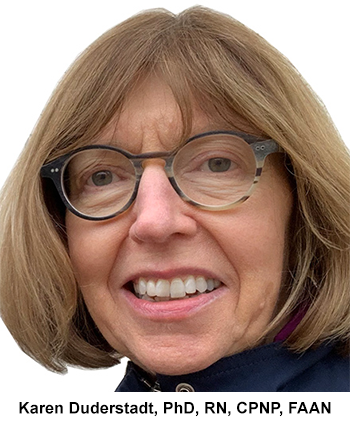
Students can join the class and engage in a live chat or access the content later, using other online discussion forums to continue the conversations. Faculty provided various opportunities for students to demonstrate competence.
“It was a lot of work, but I think it was worth it.”
Karen Duderstadt, PhD, RN, CPNP, FAAN, recently retired from UCSF as a Clinical Professor and Director of the Pediatric Nurse Practitioner (PNP) program. As emerita faculty, she continues to teach as a guest lecturer in small-group pediatric seminars discussing clinical cases and child health policy issues. As such, she has had to adjust her ideas about the optimal setting for teaching and learning.
When the pandemic struck Duderstadt was asked to teach her seminars online.
“The seminars initially felt less engaging as some students were not required to use their Zoom cameras, and the socialization among students and faculty was often missing,” she said.
Still, she cited benefits of the approach including the convenience for both faculty and students, especially those juggling family responsibilities or no longer living in the Bay Area.
“There is a potential for more synergy between medicine and nursing through this approach, which is wonderful for building interprofessional teams in health care,” she said.
Still, she wonders about the impact of the curriculum on the students.
“We need to do some close evaluation,” she said. “I think for now we will stay online. The question is, what have we lost?”