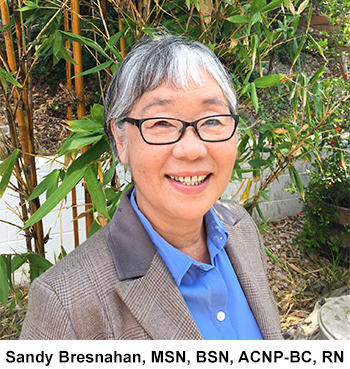
Sandy Bresnahan, MSN, BSN, ACNP-BC, RN
Focus On… is a Q&A style interview that highlights a member, a conversation with an authoritative expert, spotlights an innovative program, or profiles a trend. If you have a suggestion for a person or topic we should consider as a future Focus On… subject, please email CANP at admin@canpweb.org.
Sandy Bresnahan has been a nurse practitioner for 21 years. She is an Assistant Clinical Professor at the University of California, Los Angeles (UCLA). She is a voting member of the Institutional Board at the Veterans Health Administration Greater Los Angeles (VHAGLA). She graduated from UCLA in 2000 then started her career at a private internal medicine practice. In 2004 she joined VHAGLA, working in the Perioperative Service line. In 2009 she began volunteer work with a non-governmental organization providing primary medical care to underserved populations locally and the world beyond. She has travelled and worked in Vietnam and Peru, as well as the Dominican Republic, Haiti, and India, and created a short-term medical mission to Sierra Leone. Currently she directs the NGO’s Peru program and brings a medical team to Peru each year. She continues her work at VHAGLA in Home Based Primary Care for homebound and other veterans. Caring for those in need is her calling. Providing access to medical care is her quest.
 Connections:
First, let’s talk about your work in home-based care for veterans.
Bresnahan:
At the VA, where NPs have full authority, I provide medical care to veterans who have difficulty accessing medical care. I am part of a team that includes a clinical psychologist, an OT, a registered dietitian, and a social worker. I also have a consulting pharmacist and physician.
My patients live in Los Angeles, where the VA has significant medical services, but where veterans can’t always access care. Our team bridges access to care. It is known that the highest utilizers of ERs and hospitals are patients who do not access routine medical care, especially our elder patients.
When a primary care provider in a clinic setting feels their patient is not able to care for themselves, or they have missed multiple appointments for whatever reason, they may refer the patient to us. I do the initial visit at their home, and if I feel they are a good candidate for our home-based program, other team members do their own clinical evaluations and make recommendations. For example, the OT counts how far it is from the front gate to the front door to make sure it’s safe for the patient to walk. If it’s not, she figures out what we can plan to provide for them. In the VA system, durable medical equipment is free. After 30 days we meet to discuss the care plan.
Everyone on the team has an equal voice. If the team feels someone needs a higher level of care, we work with the patient, family, and caregivers to help transition the patient to a safe place. This intensive management of patients at risk, while expensive, has been shown in studies to save the VA medical system millions of dollars a year.
Connections:
How is the provider-patient relationship different in home-based care?
Bresnahan:
When you are a clinician in an office the clinician has all the power. When you visit a patient in their home, you are a guest. If they don’t want to hear what you have to say, they will show you the door. Being in their home makes them feel empowered to ask questions to say what they do or don’t like. We go through my list and their list of what needs to be done to maintain health to age in the home safely. We mutually formulate a plan. I always address their number-one issue. This gets me buy-in to move forward collaboratively. This type of medical/nursing practice is not for everyone. Before a new NP is hired, we take them for a ride-along. Some will say, “This is not for me.” For me it’s a calling.
Connections:
When did you start going on international medical missions?
Bresnahan:
I have always been interested in public health, and I was feeling that call. About 10 years ago, I connected with an NGO called Global Health Force, and my first mission was to Vietnam, where I returned several more times. I then went to the Dominican Republic, Haiti and India. For the past six or seven years I have been leading a team of about 16 volunteers that goes to Peru to provide medical care every August for nine days. Together we see about 1,200 patients per mission.
Connections:
How do you prepare for these missions?
Bresnahan:
We start making plans in January. Peru has a lot of different rules, and it takes an 8-inch pile of paperwork that we take the Consulate for approval ahead of the trip. We order all the medications that we use to stock our traveling pharmacy. Everything is squared away by July.
Connections:
Who are your volunteers?
Bresnahan:
Nurses, NPs and MDs are our providers. I try to bring an optometrist because we provide eyeglasses. I have a great dentist working with me from Cuzco who will fill some cavities and pull unsalvageable teeth. A team member provides dental education. Everyone who comes to the clinic gets a toothbrush. A physical medicine physician at the VA helped me to develop a PT program, which is only sustainable if I have a volunteer PT that year. The exercises taught through this program are a source of non-pharmacologic relief for musculoskeletal pain. We see many patients whose primary work is manual labor, be it in a rural or urban setting. We have volunteer interpreters from the University of Trujillo. Some of them are medical students.
Connections:
How do you set up your clinics?
Bresnahan:
We conduct four clinics over the 9-day trip in two locations. Often it requires us to fly to the nearest airport and then take a very long bus ride. Each clinic is put together from the ground up. The team may be in the same town or village, but to give easier access to more patients we set up as directed by our country sponsor. Upon arrival I do an assessment of the site, then we offload our gear and supplies and set up. The team gets one day off in Lima between the two clinic locations.
Connections:
What sorts of medical problems can your team address?
Bresnahan:
We travel to Peru in the Southern Hemisphere at the end of winter. This equates to respiratory infections, asthma, and seasonal allergies, as well as the usual hypertension, diabetes, anemia, constipation, and a lot of muscle and joint pain.
We provide medical evaluation, optometry, dental care, PT, and a pharmacy that can fill the prescriptions written by the medical providers. We do a lot of education. For example, if we see a diabetic, we can give them meds, but there is just a 50-50 chance that they will take them. I try to educate them about the role their diet plays in their health. In Peru, they always eat bread, rice and potatoes. I can ask them to take one of the items out of their diet. Then we give them a plan. Also, it’s important that we show them the value of the fruits and vegetables that grow in their region. For example, the papaya is full of vitamin A, and papayas are good for constipation. They know it, but they think maybe we have something better.
Connections:
What are your limitations in caring for people in Peru? Can you make progress in improving the population’s health?
Bresnahan:
My providers get a little talk before the first clinic, usually on a long bus ride. It is about what we can do and a reminder that this is not “back home.” I ask them to look at the people we are caring for and consider the risk/benefit of a prescription before writing it. I ask them to listen to the patient: is there a good heath practice that merely needs validation? I also give them a heads up on what is available for follow-up care, reminding them that most, if not all, patients they see will not go to a laboratory for follow-up blood work. A patient once told me he knew his sugar was high when the ants make a trail to his urine. While I have built bridges to specialty care at no cost to the patient, I find that many will not leave their village to access this care. You do the best with what you have, and you really appreciate the abundance that you have when you come back home.
The women we see are the ones who can change things slowly. I went back to one village where some of the women had participated in one of our physical therapy sessions. They were using the stretches and teaching their husbands to do them. Women talk among themselves. They say, “I did this, and I feel so much better.”
The bells and whistles that bring these patients to our clinic are a means to get buy-in. Sustainable improvement of wellbeing is through education, teaching what they can do to maintain health, and validating the good health practices these patients already employ.
Connections:
Are there any liabilities associated with the work you do in Peru?
Bresnahan:
You have to know the country and what their laws are. I have someone in Lima who takes the paperwork from the Consulate and gets it all signed off on. He helps me get safe transport. I work with Caritas International, a Catholic organization, which is our country sponsor. When I bring the paperwork, they want to know exactly where I am going, how long I am going to be there, and what services will be provided. Once there, we have two tenets: the safety of the team and do no harm. After each clinic my pharmacist will send papers back to me, and every night I go through every one of the documents to make sure it’s safe.
Connections:
What are the benefits for the team?
Bresnahan:
When I take a group, no one knows each other. By the end of the trip, they are one, big, unified family. We start out on the same page of wanting to do good and help others. This may seem crazy, but even though we are tired, it’s hot, it’s hard work in close quarters, as much as we do for patients, I think they do more for us. It’s like food for the soul.